Knits That Speak, Women That Rise: Kendall Ross and the Art of Women’s Stories
What do art, women, and knitting have in common?
History, culture, tradition, and yes, a lot of power.
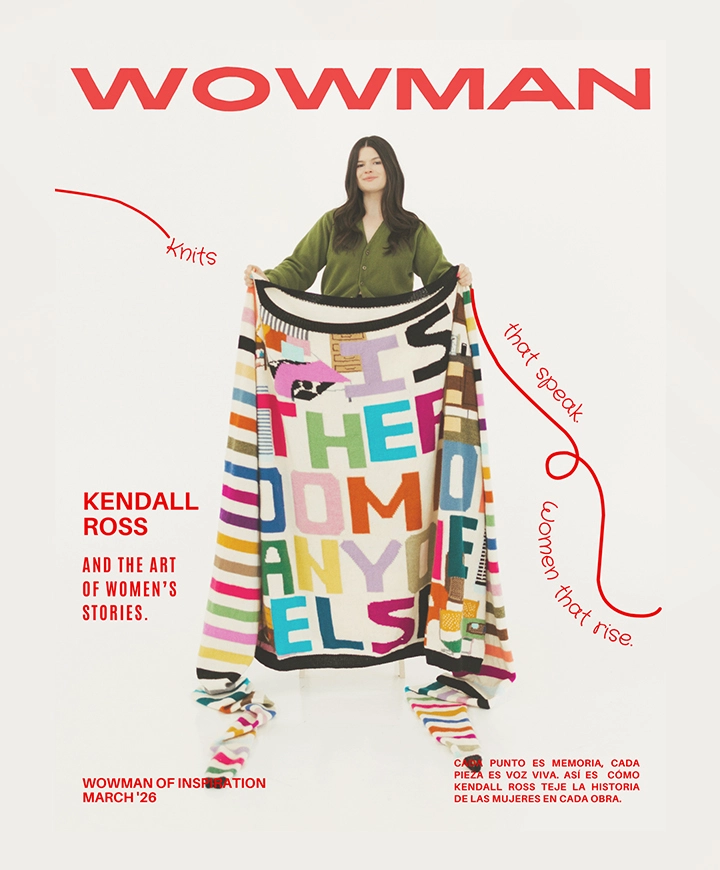
In this virtuous circle of history, culture, and women’s art, we find the name Kendall Ross—also known as «I’d Knit That» on social media—a textile artist from Oklahoma City, known for her colorful, hand-knitted art pieces, perfect for wearing but also for giving visibility to the voices of millions of women.
Throughout her childhood, Kendall was drawn to textile art, learning to crochet with her maternal grandmother. The close relationships she forged with the women in her family through knitting and crocheting inspired her interest in women’s history. With a BA in American History from Pepperdine University, she researched racial divisions within the knitting movements of Black and white women during World War I. Her background as a historian inspires the content and the purpose behind her art.
In her day-to-day practice, the action of hand-knitting is how Kendall processes her emotions, experiences, and memories.
She uses intricate hand-knitting colorwork methods like intarsia and fair isle to illustrate images and incorporate her original texts into the fabric of her work. Each stitch on every sweater, vest, mural, and textile is painstakingly planned and knit over countless hours using two needles and wool.
Kendall is leading a revolution of textures, where two needles are tools of change and knitting is the conduit for a new female empowerment. Kendall seeks to redefine the perception of both textile art and hand knitting in fine art spaces, challenging others’ perceptions of what is and isn’t art, and who decides.
In this exclusive interview for WOWMAN, we explore Ross’s cosmogony: a universe where every wool yarn speaks and women are elevated through conscious creation. nIn the context of International Women’s Day, we highlight Kendall’s textile art, which redefines what it means to be an artist today.
What do you think is the wowness/power of art and knitting?
I think knitting has a unique wowness because of the extreme labor that goes into creating an object with your hands out of essentially nothing. When you see something hand-knit, it’s almost shocking to think about how much time it took to not only create the piece but to learn the skill. I think there’s so much power in putting so much of yourself into an object.
What first drew you to fiber arts, and how did your grandmother’s influence shape your creative path?
I grew up surrounded by women who were constantly creating with textiles and fiber. I looked up to and wanted to emulate them, so I joined in on the experience of making things. Being in that environment, I’ve always loved the process of creating work, and I’ve never stopped. My grandma was the one who taught me how to crochet. She was incredibly creative and always devoted herself to making things for others.
How does your personal story or background shape the themes and emotions in your work?
All of my work is very personal and draws from different aspects of my life and background. I’m inspired by my feelings and emotions in the present and often use knitting as a way to process them. Similarly, I often reflect back on memories and experiences from my past, examining their current impact. Recently, I’ve been thinking a lot about specific experiences growing up in Oklahoma within evangelical spaces. My piece “The Pew” comes directly from those reflections.
Fiber arts have deep roots in women’s history. How do you see your work continuing or challenging that tradition?
I have a background studying women’s history and a deep appreciation for my own familial history and its ties to fiber art. In my work, I’m passionate about celebrating the women who carried on and passed down textile traditions. However, I’m eager to challenge long held beliefs about historically woman dominated crafts in fine art environments. By both continuing and challenging tradition in my work, I hope I’m able to encourage people to celebrate knitting from the past and knit work we’ll see in the future.
What do you hope viewers feel or discover when they encounter your art for the first time?
I’d hope when someone sees my work they’re feeling something along the lines of “wow – I thought I was the only one who felt this way.” In each piece, I’ve always tried to be as vulnerable and open as possible, allowing room for others to feel their feelings to the fullest extent. I think I’ve often felt people relate to my work just because they see a piece of themselves in it, whether it’s through the text or the imagery on the piece.
Is there a particular piece that feels like the most personal reflection of your inner world?
My piece “I Remember Thinking Things Would Change Once I Didn’t Take Up So Much Space” feels like the most personal reflection of my inner world. There are so many objects knit into that work that hold so much meaning to me and feel symbolic for the things I think about and continue to go back to.
Can you share a challenge you’ve faced in your artistic journey and how it transformed your creative process?
I’d say the overarching challenge in my artistic journey is the perception of knitting within fine art spaces. While it’s frustrating that so many people exist with an art vs. craft mentality, the questions brought up have positively influenced my creative process. I’m able to think deeper about my own beliefs and respond through the text of my work.
How do you see your work contributing to broader conversations in contemporary art and society?
I see my work as impacting how contemporary art treats craft-based practices. While I’m still doing the same knit stitch people have always done, I’m hopeful that by pushing scale, form, and vulnerability within knitting, people will challenge their own believes about knitting and other fiber art practices.
What advice would you give to someone who wants to start making art?
I’d tell someone wanting to start making art to give themselves time to practice and learn at their own pace. It can be frustrating to be a beginner, especially with the amount of people we see on social media every day who are making it seem so easy to create something beautiful in 15 seconds. Learning new skills takes time, but it’s worth putting in the effort.
What’s next for Kendall’s art? Do you see yourself making art in a different way?
I see myself taking the essence of what I’ve been creating over the past few years and combining it with new forms and ideas. I don’t want to create the same kind of work forever, and I want to push myself to new boundaries of what’s possible with hand-knit work.
Kendall Ross’s work reminds us that crochet is much more than a technique; it’s a choreography of resistance. And yes, it’s art. In every stitch there is a decision, and in every garment, a story that refuses to be silenced.
The art and ritual of textile art forces us to stop, to feel the texture of our own narrative, and to understand that our power lies in the patience to create ourselves. Kendall doesn’t just crochet clothes; she weaves bridges between who we are and what we dare to say. When women raise their voices—or their needles—the echo resonates not only in the yarn but in all those who come after, ready to rise up. Knits That Speak, Women That Rise is not just a title; it’s the promise that, stitch by stitch, we are designing a future where our voice is legacy.